Types of Men: A basic guide for women

Types of Men: A basic guide for women

Contrary to popular belief, men aren’t easy to comprehend (yet, predictable) as there are different types of them which you can find reflections of, in the animal kingdom. 

Each type has its own characteristic traits and have different expectations from women.

Let’s have a quick look:

The ox: About 35% of the male population consists of them. They are easily identifiable in society with their bulky and muscular bodies with grim expressions all over their faces. They tend to think all women are attracted to the looks of their muscles. They are the least intellectual type of all and it’s nearly impossible to strike a rational conversation with them. They are highly overprotective and tend to see women as personal properties. They want their women to be loyal and physically attractive all the time while they regard themselves not bound by the loyalty rule. Though quite primitive, the oxen are amongst the most desired by women for reasons unknown. 

Favorite hobby: Watching football with their mates in a cheap bar.

The peacock: About 15% of all men fall under this category. They are stinking rich and try to impress women by using pure wealth. The rich peacock values physical beauty and often spoils their women with costly presents. For them, women are ornaments of beauty that they wear around. They are joyous as long as the beauty lasts, so it’s easy to make a rich peacock happy: stay pretty. They are also never upset about losing their partner as they think someone will eventually replace her. 

Favorite hobby: Attending antiquity auctions overseas.

The raccoon: 14% of the males fit into this category. They are highly intellectual men and target women using their brains. They might seem bossy around women but in reality they want to be led by them. They are super talkative and can often turn into a talking Wikipedia if not resisted. As they are extremely self-confident, a woman must follow his advice on any subject, acknowledge how right he had been and show gratitude by thanking. That is rhe only thing that appeals to them. Otherwise, the raccoon would keep on nagging his partner until she does follow as he sees fit. 

Favorite hobby: Bragging continuously about how he solved a difficult crisis using his intellect in the corporate world.

The Sloth: The laziest type of all men make about 11% of the male population. They are almost always shaggy looking without a decent, paying job. Interested and skilled in art or music, they tend to live off of their women financially. They can make their women happy as long as they are taken care of and not talked about job opportunities.

Favorite hobby: Being left alone in a basement armed with crayons or a dusty old piano.

The monkey: The playful monkey can be seen in about 8% of males. They are not that attractive physically, so they try to compensate the physical flaw by playing the clown. Their sole aim is to make their partners laugh and have the greatest times of their lives. A woman can blindly trust the monkeys and can be easily entertained by doing all the crazy stuff that they have never thought of, with them. They are the perfect partner and play mate for women.

Favorite hobby: Making women happy. 

The dinosaur: Another 8% of men are dinosaurs. They are traditional and old-fashioned in every way. They are also closely bound to the unspoken rules of society 300 years ago and try to maintain such a society in an ever changing, current world. The dinosaur wants his woman to be just like him; having high values for obsolete traditions.

Favorite hobby: Telling stories about their great grandparents over and over again.

The dragon: 0% of men…They are what every woman wants as partners but sadly they don’t exist. Never have.

Favorite hobby: Existing in the dreams of women up to a certain age until they realize they don’t exist.

The remaining 9% is a cross breed between the types above. 

So, what do you think? Am I right? Please comment…
Love does not need a picture…

Someone…

Show me the existence of wordless communication, where sweet looks and gentle touches do the talking…

Turn me into a bedroom mirror, so I can watch you fall into sleep every night…and wake up with every light…

Equip me with a brand new collection of a 1000 words of love to describe my never-ending feelings…

Allow me to enclose you all over in my octopus arms…

Kiss me so deeply, sucking the air in until it runs out in my lungs…

Build me someone immune to infinite cuddles…if you can’t be the one…

And, if that’s the case… then,

Rip my soul in two…so that I can be sure that someone capable of true love like me, exists in this realm…


P.S: Lol….the first letter of each line, spells out STEAK BAR! Perhaps, my true love…

Archaeology of the Present

dc9eaed152edc8d5d50af6a44e67d6ff.jpg
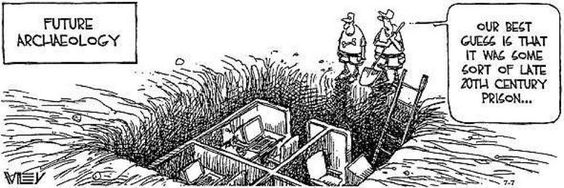
Imagine our current civilization ended up in flames; totally wiped out… a few remaining survivors of the human kind (possibly stripped of all advanced technological knowledge and know-how) started all over from scratch.
In a millennium, every advancement is already long forgotten and our civilization at present is regarded as an ancient one, pretty much like ancient Egypt in our era.
The new civilization follows more or less a similar path as ours to flourish. However, some things have never been invented or some ideas have never been thought of. At least, they invent the notion of archaeology; digging up the past (and trying to uncover our secrets).
Let’s do a thought experiment…
It’s the year 2116; a thousand years from now and the future archaeologists uncover the following:
palenque589446089_tp.jpg
1. The personal library of a sci-fi enthusiast, which survived a millennium in a nuclear shelter/bunker. All the books that survived are works of fiction…about intergalactic wars, time travel, aliens, etc… and after decades of hard work, they are able to crack the code of our language. What would they think? Would they regard them as works of fiction or consider them as ancient history? We seem to regard every written record of ancient civilizations as real…
2. An email message printed on a browned out paper (actually the paper browned out much later :), containing letters of the alphabet as well as characters like @,#,_,&,* and :). (From the same library mentioned above) Would they combine these symbols into our ancient language and overthink about their function?
baseballbat2
3. A dozen autographed baseball bats by some of the baseball idols of our era dug out from the ruins of a sports shop. Luckily, the UV coating on the bats preserved the signatures from smearing out through ages. What would a baseball bat suggest to a culture who has not invented the concept of sports (for entertainment)? Perhaps, a primitive weapon of war; inscribed with an ancient god’s name to channel divine power to the wielder? How about the sports shop? Would the future archaeologists be happy that they unearthed an ancient armory?
4. A huge, curvy water slide in an abandoned amusement park: An aqueduct?
alienhands002
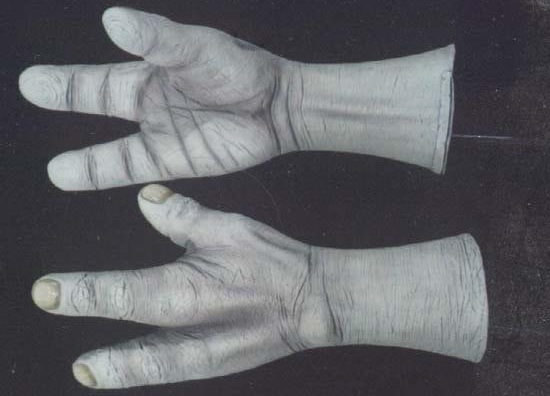
5  A bowling ball… Let me be more specific: A size 14, shiny, purple bowling ball. Hmmm… What are the three holes for? For fingers? But why three? Would they think that ancient humans had two less fingers? Oh wait! That’s how we depict some aliens!!!
The moral of this article?
No matter what your intentions are (when you invent or create something), you will most likely to be misunderstood …

How long is time?

A second, a minute, an hour, a day, a week, a month or a year…are some of the time related vocabulary invented by us; people, trying to have a global standard in measuring time. It’s a good thing that we had the movement of the sun to base our newest concept on or else we would be timeless in a maelstrom of confusion.

But!

Is each unit of time mentioned above, really the same in length for everyone or are they subjective?

A minute feels like eternity at your first kiss …

Perhaps, we feel that way because 1 minute is 60 seconds…and 60 is more than 1… regardless of the word that follows it.

A minute can also feel much shorter than a millisecond when you’re standing by the deathbed of a loved one.

The same logic can be applied here as 1 minute can be 0.0166666667 hours which is a tiny fraction of a whole.

The moral?

No matter how long it is…a minute is never sufficient.

Why we like what we like

As technology keeps developing, we start drifting away from other individuals of flesh and blood close to us, trapping ourselves in prisons of solitude of our own doing (like social media…and oh! The irony!). Soon, we realize what we are desperately looking for… ; being connected to others in the first place, creating a weird dilemma … perhaps strangers but people…to real people who are geographically distanced hundreds of miles apart.

Our quest to find such connections has also affected the language we had been using for ages in unimaginable ways (though if I’m writing it here, it’s imaginable). 

The term “selfie” is a good word to demonstrate how much we progressed in terms of being connected to others; the society. 

The verb/slash preposition “like” nearly became more commonly used in its “noun” form in an overnight with the sudden impact of the social media like (here it’s a preposition) Facebook, Twitter and instagram. As we started liking (and here it’s a verb) weird looking babies’ pictures along with photos of cats, we started enjoying the impact of being liked by people whom we have never met in person. Then, the number of “likes” (and here it’s a plural noun) started to matter. Some people even paid (or still pay) money to purchase virtual followers or automatic likers. The quality of the content we like has also degraded from real works of art to masterpieces of rubbish that our stranger friends post daily. We like to be liked and this makes us proud somehow.

Here are the specifics of a social experiment I did a while ago: I posted the picture below on one of my social media accounts without a caption and guess how many “likes” I got?

38 likes within minutes…Wow! Maybe I do have some artistic qualities I’m not aware of.

P.S: Hit the like button for this article to honor the content and I’ll like one of your…err…stuff you posted online. 

Smart Phones and whatever

Alexander Graham Bell’s dream was to be heard over a distance; a mere voice projection and nothing else; a device solely responsible for communication. What would he be thinking if he lived now, in the era of smart phones; seeing his invention taking a weird turn and becoming a device of self isolation and addiction? I bet he wouldn’t be so content as we’re not really using smart phones for their main functionality which is basically to speak to people.

We can take photos, send letters (emails), log into our bank accounts, play games, watch movies, make movies, like pictures of cats, listen to music, apply for jobs, remember and celebrate birthdays, use them as flashlights, look for directions, check weather reports, plan our holidays, chat with complete strangers, absorb radiation and develop brain tumors.

We can do all of these without uttering a single word and most of them without involvement of a second body.

So, what happened to the communicative aspect of phones?

The answer is obvious: Nobody cares anymore as long as they have the latest device, access to social media and a wall charger.

This is all for now. I have to stalk some stranger’s profile and watch funny cat videos.