In Part 1, we situated the manuscript within genuine 15th-century botanical and material traditions. In Part 2, we introduced the Dual-Layer Hypothesis, decoupling the high-frequency operational engine (qok-, ol-, ot-) from unencrypted trade insets (daira, sard-a, otolora).
Now, we move from theoretical syntax to physical reality.
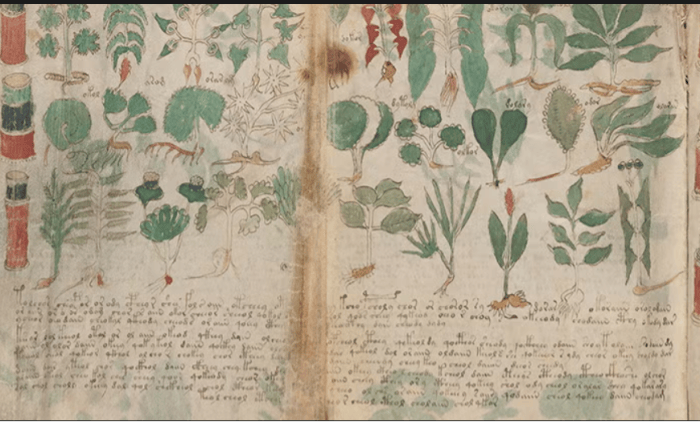
For centuries, the most perplexing visual transition in the Voynich Manuscript occurs between the pharmaceutical pages—stacked with severed roots and ceramic apothecary jars (albarelli)—and the balneological pages, where rows of nude figures bathe under strange canopies and interconnected green pipes. Viewed through traditional cryptographic lenses, these sections appear completely unrelated.
When decoded through our Dual-Layer Engine, they form an uninterrupted, room-scale industrial pipeline: the preparation of concentrated botanical extracts in the laboratory (Folio 88r) flowing directly into the delivery manifolds and soaking basins of the bathhouse (Folio 84v).
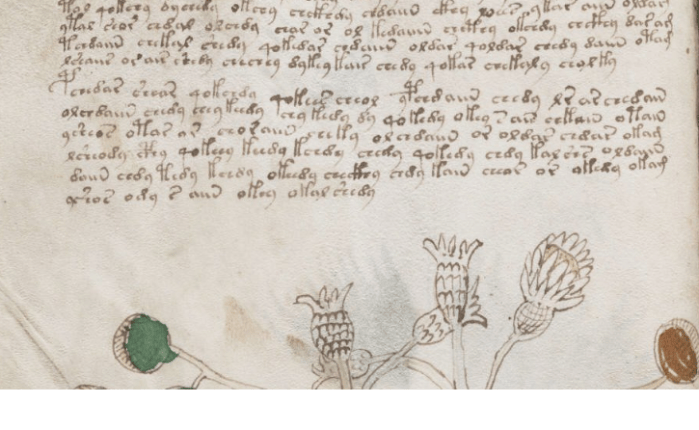
Step 1: The Extraction Laboratory (Folio 88r) Folio 88r does not present a narrative description of plants in the wild. It is an apothecary compounding manifest and processing inventory. Along the left margin sit tall ceramic storage jars (albarelli), while the right side displays isolated, severed root cuttings, rhizomes, and a distinctive broad pad leaf.
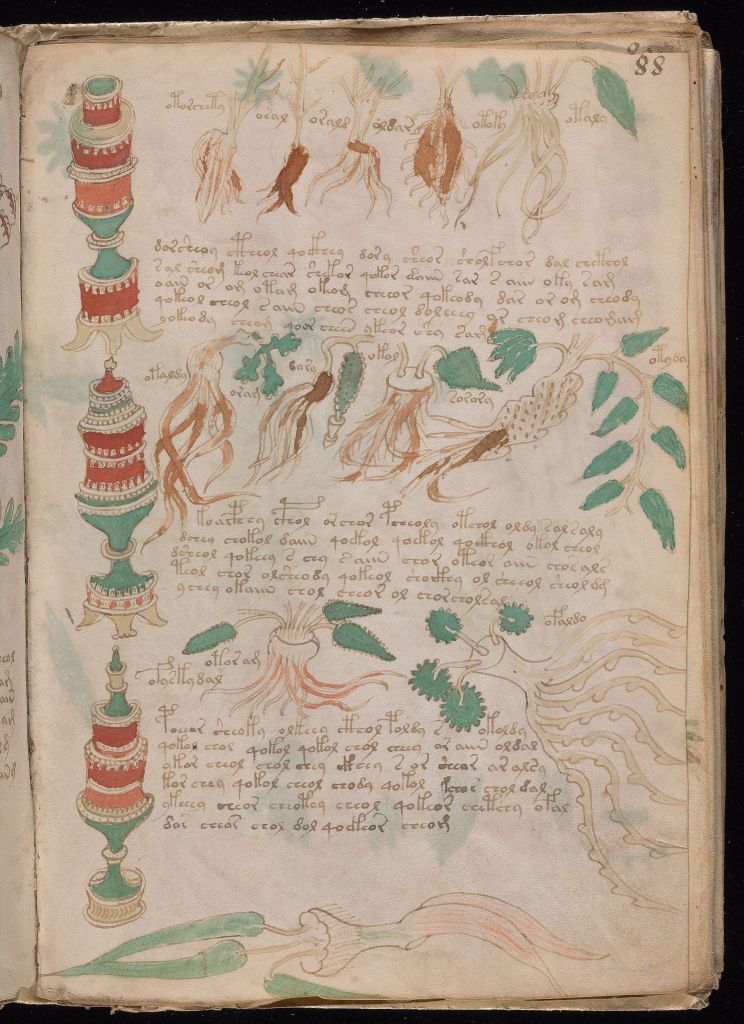
LABORATORY EXTRACTION: FOLIO 88r
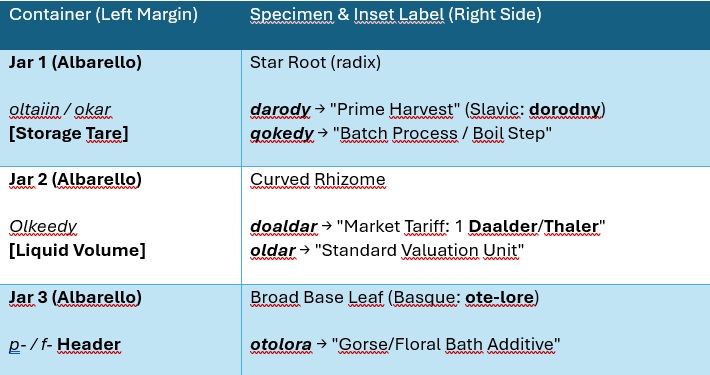
The Extraction Syntax on 88r
The text surrounding the plant cuttings operates as an operational compounding recipe:
- The Valuation & Storage Labels: Next to the top jar, oltaiin / okar marks the vessel’s liquid capacity and primary heat state. The standalone label doaldar (cognate with the Low German/Frisian daalder or silver thaler) records the market tariff or batch valuation of the processed resin.
- The Botanical Descriptors: The star root is designated as darody—a direct phonological match for the Hanseatic/Slavic commercial trade descriptor dorodny (prime, ripe, prime-grade stock).
- The Active Component: Beside the large lower leaf sits the unencrypted trade loanword otolora. Combining Pyrenean/Basque ote (gorse/broom bush) and lore (flower), it designates a known late-medieval anti-inflammatory, diuretic steep used to treat joint and skin inflammation.
At the bottom of Folio 88r, the opening lines of running text synthesize this preparation:
[f] p-or-ain qok-edy ot-ol-dain sark qok-ain ol-sain
“Primary yield stock (p-or-ain): Heat the batch (qok-edy) of expressed fluid reduction (ot-ol-dain), adding the binding agent/filter (sark); apply primary heat (qok-ain) until reaching a purified liquid state (ol-sain).” The laboratory has completed its run: the gorse flower extract (otolora) has been macerated, reduced into a purified oil medium (ol-sain), and racked into the albarelli for transport.
Step 2: The Bathhouse Delivery Manifold (Folio 84v)
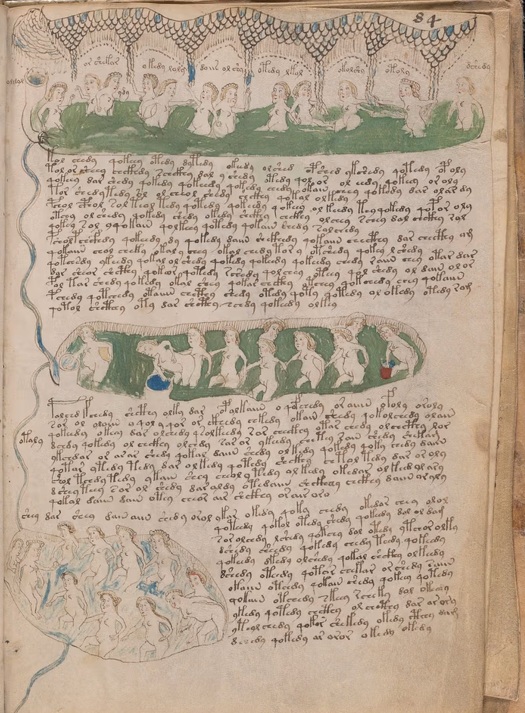
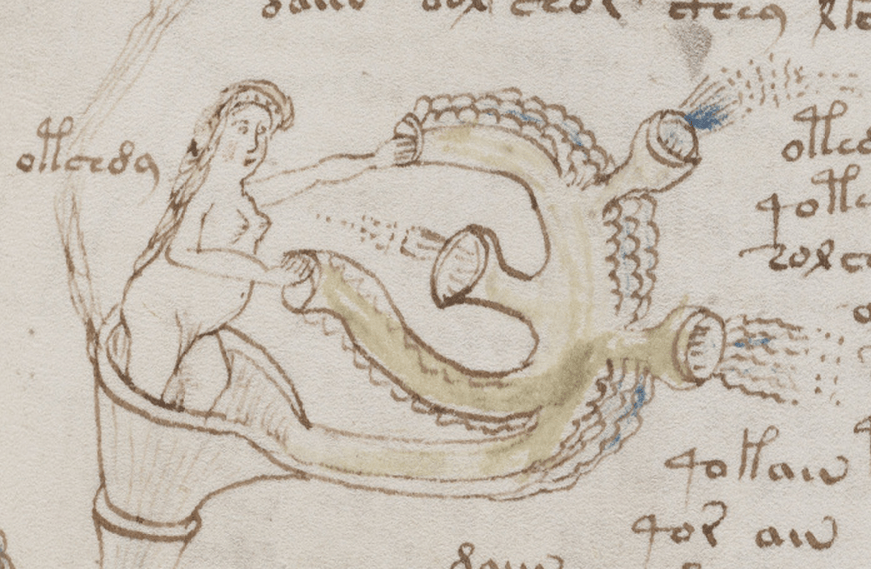
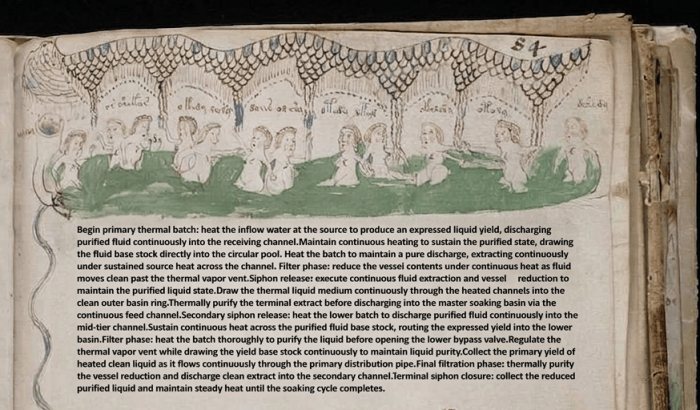
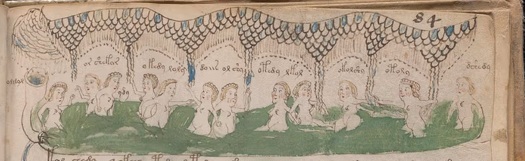
Turning to Folio 84v, we enter the treatment chamber. Here, the abstract jars and severed roots disappear, replaced by physical hydraulic architecture: an overhead distribution canopy with individual nozzle streams, an intermediate recirculating pool, and a lower vapor basin fed by a continuous delivery conduit.
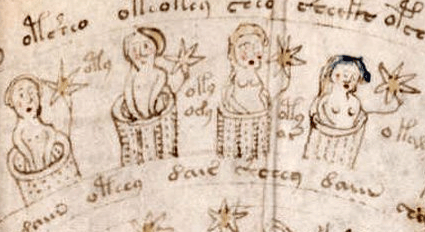
And directly above the sixth bathing figure in the top canopy sits the exact same token from Folio 88r: otolora.
HYDROTHERAPY CANOPY: FOLIO 84v Overhead Distribution Conduit (eey)
The Facility Flow Architecture
- Top Canopy (12 Arches): Overhead manifold delivering targeted sprays. Calibrated to the 12-month calendar or 12 distinct treatment steps.
- Left-Margin Conduit Pipe (tubulus / eey): Snakes down the page, diverting excess fluid from the canopy into the lower basins.
- Middle Recirculating Basin (10 Figures): Immersion bath where water from the overhead streams collects and recirculates.
- Lower Steam Basin (11 Figures): Cloud-like vapor pool positioned over the hypocaust heat run where mineral sediment settles.
1. The Canopy Nozzle Sequence
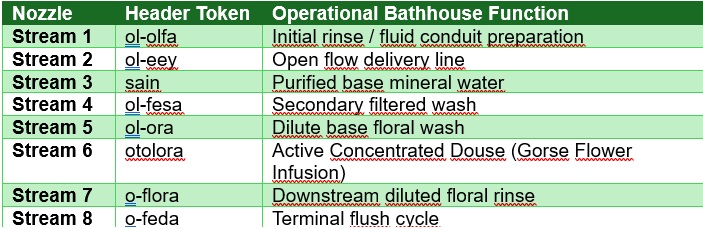
Across the top arc of Folio 84v, the header labels above each bathing figure form a morphological gradient showing the fluid state transition:
ol-ora > otolora > o-flora
- ol-ora (Nozzle #5): Base fluid wash (ol- liquid medium + -ora floral extract).
- otolora (Nozzle #6): The concentrated active steep prepared on Folio 88r (ot- expressed extract + Basque ote-lore) administered as a targeted topical douse.
- o-flora (Nozzle #7): The secondary, diluted floral rinse exiting downstream.
2. The 12-10-11 Facility Regimen
The counts of figures arranged across the three tiers—12 at the top canopy, 10 in the middle pool, and 11 in the lower vapor basin—are not decorative. In late-medieval balneology (as documented in the Tacuinum Sanitatis and De Balneis Puteolanis), hydrotherapeutic regimens were strictly calculated by exposure duration, temperature steps, and astrological health calendars (Regimen Sanitatis):
- Top Canopy (12 Arches): Calibrated to the 12-month calendar or 12 distinct treatment jets, specifying which floral infusion to route depending on the season.
- Middle Basin (10 Figures): The primary immersion bath where water from the overhead jets collects and recirculates.
- Bottom Basin (11 Figures): The lower, cloud-like vapor pool where heavier mineral sediment settles and rising steam warms the chamber.
3. Pipeline Flow Control
The block of text positioned between the top canopy and the middle basin sits directly beside a prominent blue-and-red pipe snaking down the left margin. Decoded with our Character Grid, it functions as a fluid diversion protocol:
p-eey o-eeda q-otleey ol-eey…“Maintain line flow through the conduit (p-eey); run the prescribed steeping cycle (q-otleey) through the fluid channel (ol-eey), then divert the otolora infusion via the left conduit into the middle recirculating basin once the upper douse cycle completes.”
The Integrated Operational Pipeline
When we step back and link Folio 88r and Folio 84v, the manuscript ceases to look like a disjointed collection of random drawings. Every page occupies a precise station along a single operational chain:
- Stage 1: Raw Ingredient (Folio 88r)
Harvest and quality grading of the plant cutting. Recorded as otolora (Basque: ote-lore) and graded as darody (Slavic: dorodny, prime stock).
- Stage 2: Laboratory Processing (Folio 88r)
Maceration, boiling reduction, and racking into storage jars. Logged with procedural commands like qok-edy (batch boil) and ol-sain (purified oil base).
- Stage 3: Inventory Valuation (Folio 88r Margin)
Batch weight, container tare, and tariff pricing logged beside the jars. Marked as doaldar (1 Daalder/Thaler) and oltaiin (container capacity).
- Stage 4: Hydrotherapy Application (Folio 84v Canopy #6)
Directing the concentrated infusion onto a bather in the prescribed chamber. Executed via line label otolora (active douse nozzle) and procedural rule p-eey (conduit flow protocol).
The author was not hiding heresy or recording alien visions. They were compiling a comprehensive, modular operating manual for an advanced late-medieval thermal spa—tracking valuable botanical medicines from the moment they were unbundled, graded, and boiled in the laboratory to the exact nozzle that sprayed them over a patient in the bath.
In Part 4, we will zoom out from the treatment room to the master site plan: analyzing the famous Rosettes Foldout (Folio 86v) to see how volcanic springheads, water pressure towers (castella aquae), and geothermal furnaces powered the entire facility.