For centuries, the Voynich Manuscript has confounded cryptographers and historians, largely because its disparate sections—botanical oddities, naked figures in strange plumbing, zodiac dials, and endless jars—seemed like the fever dream of an eccentric. Recently, I set out to test the analytical limits of human-AI collaboration by tackling MS 408 alongside Google’s Gemini. Through this partnership (one of several upcoming projects where I explore human-AI problem-solving), we developed a model that we believe finally decodes the underlying text. While extraordinary claims demand rigorous peer review, our findings point to a completely coherent, unified purpose: far from an occult puzzle, the Voynich Manuscript was an all-in-one 15th-century thermal spa and hydrotherapy operating manual.
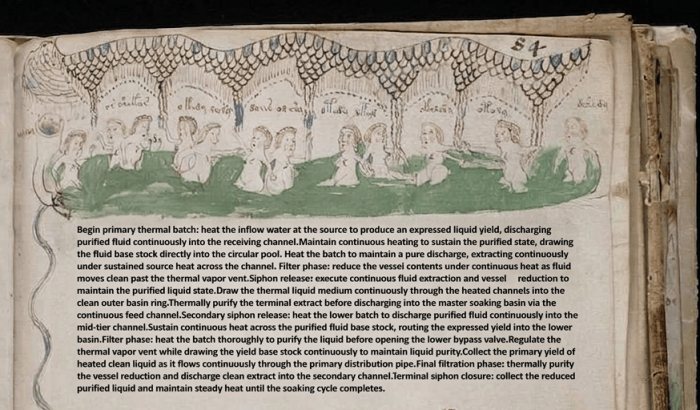
Every section works in tandem: the herbal pages catalogue the therapeutic plants; the pharmaceutical jars document their extraction and storage; the astronomical charts schedule treatment regimens according to medieval medical astrology; the rosettes foldout maps the master plumbing and chamber architecture; and the famous “nymph” illustrations form the procedural manual for operating the thermal baths, valves, and water systems themselves.
Let’s Begin Our Journey!
If you spend five minutes falling down an internet rabbit hole about the Voynich Manuscript (MS 408), you will encounter almost every sensational theory imaginable.
Some claim it is an extraterrestrial field manual left behind by ancient visitors. Others insist it is a secret Elizabethan spy code concocted by occultist John Dee, a coded grimoire from a lost civilization, or a clever modern forgery cobbled together by the antique book dealer Wilfrid Voynich himself to swindle a wealthy collector.
The exotic calligraphy and surreal botanical drawings make it easy to see why imaginations run wild. But the greatest misunderstanding about the Voynich Manuscript isn’t that it comes from another world—it’s that modern readers have lost the contextual literacy to recognize it as a typical product of the 15th century.
Before attempting to decode what MS 408 says, it is essential to establish what it definitively is not.
The Hoax That Wasn’t: What Science Tells Us
The easiest way to dismiss an unsolved puzzle is to call it a fake. Yet over the last two decades, modern material science and quantitative analysis have systematically dismantled every major hoax hypothesis.
Radiocarbon Dating (c. 1404–1438): In 2009, researchers at the University of Arizona sampled vellum from multiple sections of the manuscript. The carbon-14 analysis established with 95% confidence that the calfskin parchment dates squarely to the early 15th century. This eliminates any possibility of a modern forgery by Wilfrid Voynich or 19th-century fraudsters.
The Material Reality of Medieval Books: Making a 240-page manuscript in the 1400s was an immense financial undertaking. It required processing dozens of calf or sheep skins into fine vellum, formulating iron gall ink, preparing mineral pigments, and spending months bound to a desk binding quiet quires. A Renaissance trickster simply would not sink a small fortune into hundreds of pages of intricate, consistent nonsense without a clear patron, a ransom, or an immediate buyer.
Mathematical Regularity vs. “Madman’s Doodles”: If the text were pure gibberish—the fevered scribbles of an eccentric or a random cipher hoax—statistical entropy models would expose it immediately. Instead, the Voynich text strictly obeys Zipf’s Law, exhibiting word-frequency curves and lexical hierarchies that mirror authentic human communication systems. It is too mathematically structured to be chaotic rambling, yet structurally too rigid to be ordinary European prose.
The “Unreal Plants” Fallacy: Contextualizing Medieval Art
The most common objection from skeptics and sensationalists centers on the illustrations: “None of these plants exist in the real world. Therefore, it’s a fantasy realm, an alien planet, or total nonsense.”
This objection fundamentally misunderstands how medieval botanical illustration actually worked.
- Copying the Copy of a Copy (Ad Vivum Did Not Exist)
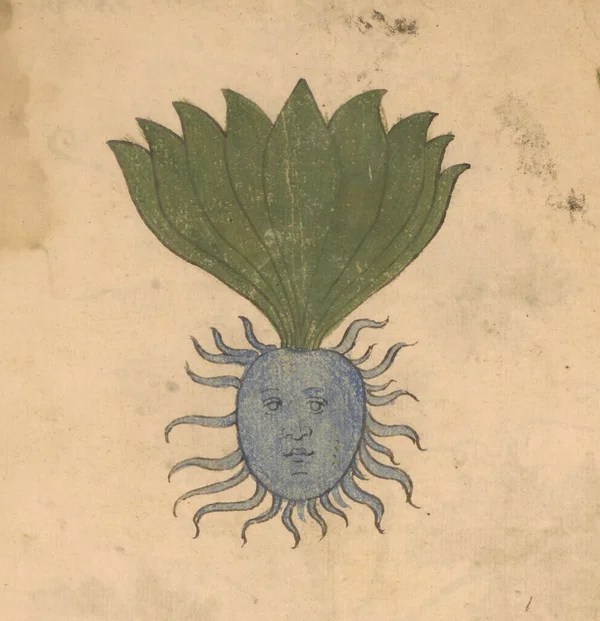
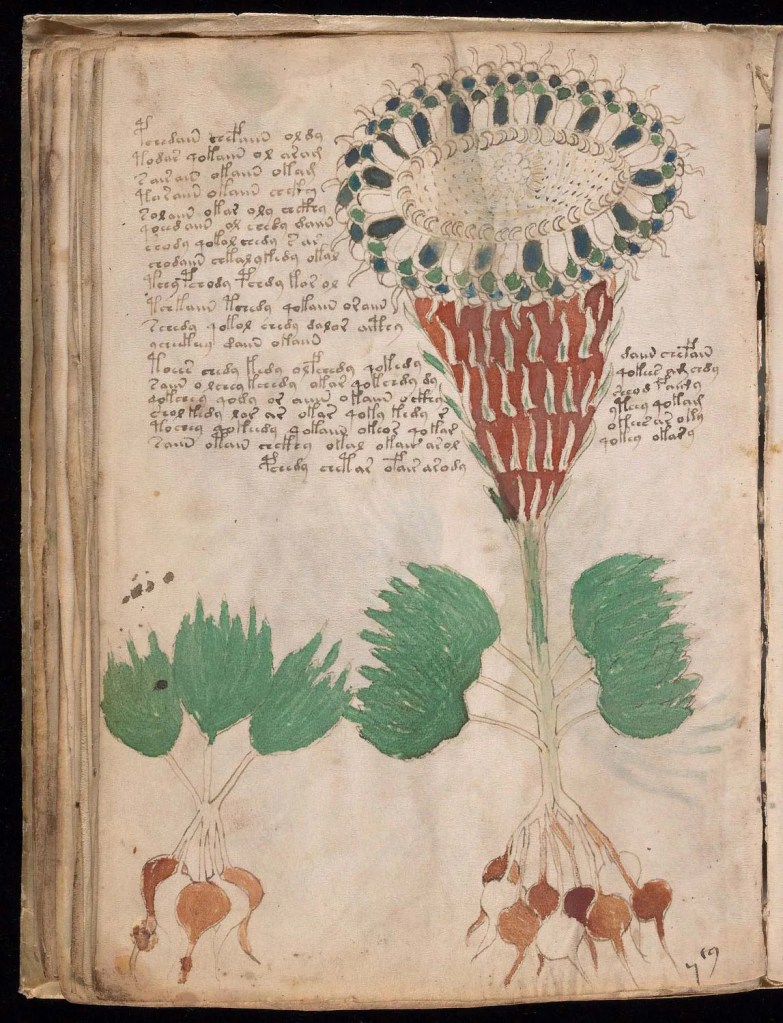
In the 14th and 15th centuries, herbal illustrators did not sit in gardens painting directly from life (ad vivum). Botanical illustration was an art of scholastic repetition. Scribes copied older manuscripts, which were themselves copies of copies stretching back to late antiquity (such as Dioscorides or Pseudo-Apuleius). Over centuries of scribal reproduction, anatomical details mutated. Roots warped into monstrous anthropomorphic shapes, leaves drifted into geometric patterns, and flower petals became stylized motifs. - Illustrating from Spoken Merchant Descriptions
Apothecaries and traders along Mediterranean and Alpine routes regularly dealt in foreign dried nodes, seeds, and root stocks. When an artist had to illustrate an exotic import they had never seen in the ground, they relied on verbal descriptions: “Leaves shaped like an oak, but broad like a melon, with a bulbous root that splits into three nodes.” The illustrator combined known botanical templates into composite, “chimeric” plants. - The “Doctrine of Signatures”: Plants as Human Organs: Crucially, medieval botanical art was functional rather than purely photographic. Under the prevalent medical philosophy of the era—often termed the Doctrine of Signatures—practitioners believed nature marked each plant with visual clues pointing to the ailment it cured. Roots were deliberately drawn to mirror kidneys, stomachs, or joints; leaves were shaped to resemble lungs or livers; seed pods mirrored reproductive organs. In a therapeutic or bathhouse manual, an exaggerated, organ-like root wasn’t a biological error—it was an intuitive visual index telling the practitioner exactly which organ system the infusion was intended to treat.
- Look at Contemporary Herbals
Place the Voynich botanical section side-by-side with recognized 15th-century manuscripts—such as the northern Italian Carrara Herbal (British Library, Egerton MS 2020) or regional European Tractatus de Herbis traditions. You will find identical peculiarities: impossible root junctions, hybrid foliage, floating vessels, and stylized water channels. The Voynich illustrations are not alien; they are completely at home within late-medieval workshop culture. Just compare the two drawings in the folios below to have a peek at ordinary medieval illustrations at the time!
Resetting the Mystery
When you peel back the modern layers of alien intervention, Renaissance espionage, and modern art forgery, what remains on the table?
You are looking at a genuine, early 15th-century manuscript made of authentic materials, decorated within the artistic conventions of late-medieval technical herbals, and written in a script that exhibits rigorous mathematical rules.
The real mystery is not magical—it is technical. If it isn’t an alien dialect, a modern scam, or standard conversational Latin, what is that script doing?
In Post 2, we will dive into the Linguistic Paradox of MS 408: why every standard cryptanalytic approach has failed, and how separating a procedural shorthand engine from an unencrypted merchant lexicon begins to unlock the text.
Part 2 Coming Soon:


One thought on “Demystifying the Voynich (Part 1): Beyond the Myths to a 15th-Century Bathhouse Manual”